
Iranian Ambassador Reaffirms Commitment to Armenia; Rejects Nakhchivan Strike Claims; Warns Azerbaijan
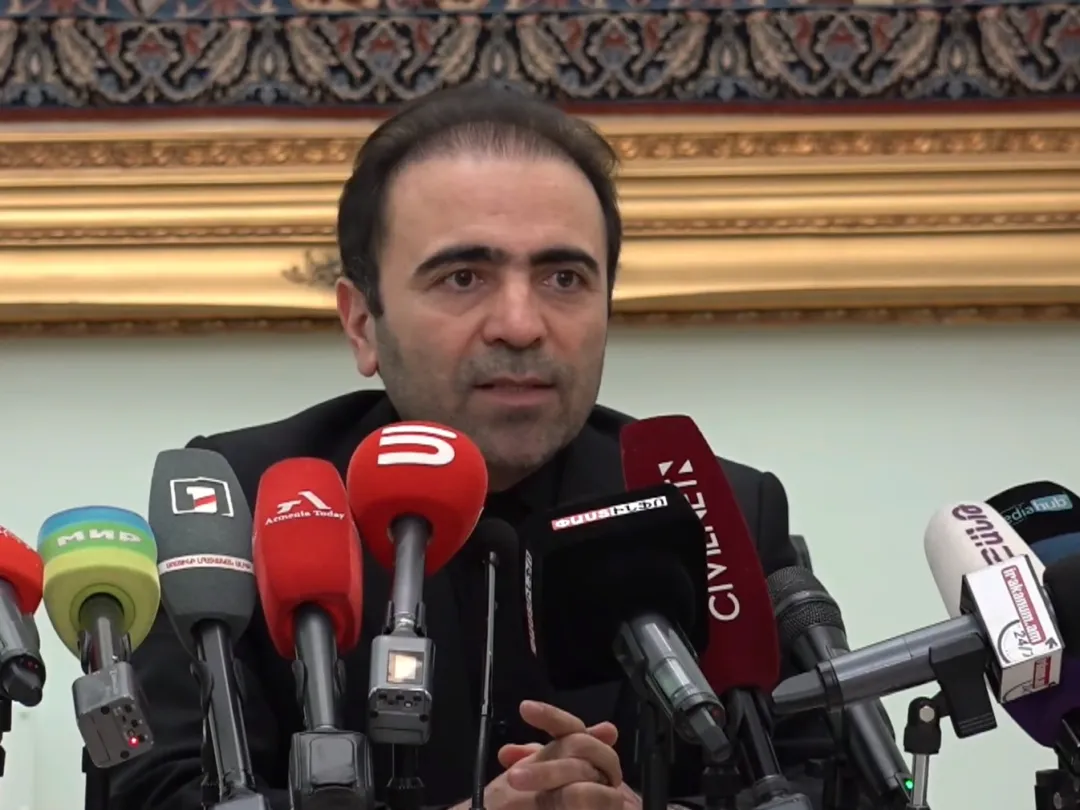
Photo: screenshot of official video/Eurasianet.org
On March 10, Khalil Shirgolami, the Iranian Ambassador to Armenia, stated in an interview with Shant TV that Iran considers Armenia’s sovereignty and territorial integrity to be of vital importance. "We have friendly relations with Armenia, based on mutual trust. We have always emphasized that Armenia's security is our security," Shirgolami stated, adding that Tehran takes this issue seriously and has repeatedly demonstrated its commitment. He emphasized that Iran does not want the ongoing war to cause even the slightest harm to Armenia.
Addressing economic cooperation, Shirgolami noted that bilateral ties between the two countries continue to function without major disruption. He stated that the border between Iran and Armenia remains open for both passenger and cargo transportation and that economic relations have not been significantly affected. "There is no significant impact on economic relations; they continue to be active and dynamic," he emphasized.
Commenting on the reported drone strike on Azerbaijan, which allegedly targeted Nakhchivan Airport and contributed to rising tensions between Iran and Azerbaijan, Shirgolami rejected claims that Iran had carried out such an attack. He stated that if Iran had made such a decision, the strike would have been precise, similar to previous attacks carried out against certain US bases and Israel. "Therefore, this incident was somewhat dubious, and Azerbaijan's response was disproportionate and unfriendly," Shirgolami stated. He added that Azerbaijan’s reaction prompted Iran’s military command to warn Baku to prevent the Israeli regime from launching attacks on Iran from Azerbaijani territory. According to him, in the event of such an attack, Iran would respond "without hesitation and with complete determination."
Shirgolami also addressed Israel’s presence in Azerbaijan, stating that Iran is aware of Israeli security activities there. At the same time, he emphasized that Tehran has warned countries in the region that the US and Israel must not use their territories or capabilities against Iran. "We want to maintain excellent, friendly and fraternal relations with all countries in the Caucasus region, and I see no reason for tension at this time," Shirgolami stated.
Speaking about the broader conflict, the ambassador emphasized that Iran is prepared to defend itself for as long as necessary. "As long as the aggression continues, the Iranian people and the Iranian Armed Forces will defend their country," Shirgolami stated.
Responding to questions about the origins of the current war, Shirgolami said that Iran had entered negotiations with a serious and sincere approach and continued them in the same manner. He noted that during the final stage of negotiations in Geneva, Iran presented what he described as a practical package of proposals aimed at achieving a comprehensive agreement. According to him, statements made by the American side following the talks also indicated that negotiations were progressing positively.
However, Shirgolami stated that the situation changed when former US President Donald Trump, influenced by "bellicose individuals in his entourage, including Netanyahu," became involved in what he described as a war of aggression. He emphasized that Iran had not ruled out the possibility of such developments and that its military forces had remained prepared. He also noted that Iran had warned that any territory used by the United States to launch strikes against Iran would become a legitimate target.
When asked whether Iran was prepared for a prolonged conflict, Shirgolami referred to the experience of what he described as a 12-day war. According to him, calls for "unconditional surrender" were later replaced by demands for a ceasefire after Israel allegedly faced strong resistance. He stated that Iran accepted the ceasefire at the time as a sign of goodwill but emphasized that a fragile truce cannot guarantee stability.
Shirgolami stated that Iran’s current position regarding a potential ceasefire requires several conditions. First, he emphasized that attacks against Iran must stop. Second, a clear legal and institutional ceasefire mechanism should be established, preferably within the UN and the UN Security Council, and reflected in a formal document. He added that the aggressor must be identified and condemned by the international community, and that the issue of compensation for damages caused to Iran must also be addressed.
"In response to further ceasefire signals, the Islamic Republic of Iran declares that it lacks confidence," Shirgolami stated, emphasizing that Iran would continue to defend itself if the attacks persist. "Iran is prepared to defend itself against this attack for as long as necessary. We have no time limit."